
Recovery
BPC-157 vs TB-500: Why Recovery Researchers Compare Them
23 October 2026 · 5 min read · Khun Editorial
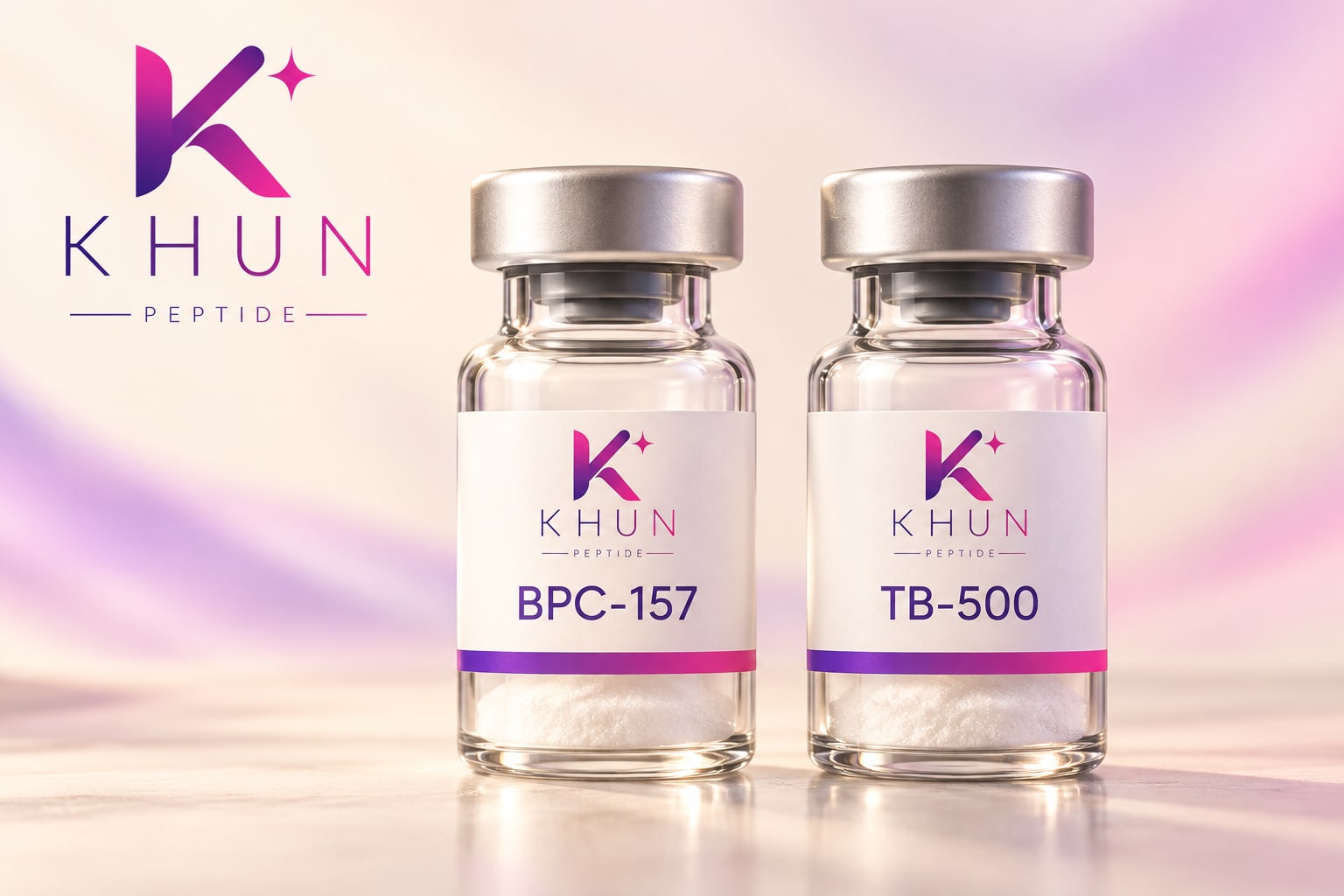
BPC-157 and TB-500 frequently appear together in searches about tendons, muscles and tissue recovery. Although they share a place in recovery discussions, they are different substances and should not be assigned the same mechanism or research findings.
Understanding their identities, the studies being discussed and the quantities on blend labels provides a clearer starting point for comparing them.
What Is BPC-157?
BPC-157 is a synthetic peptide made up of 15 amino acids. Preclinical research has investigated tissue responses in several systems, including tendons, muscles and gastrointestinal tissues.
Researchers have examined injury responses, signaling associated with blood-vessel formation and changes in experimental tissue models.
When reading a finding, check whether it comes from cells, animals or humans and identify the outcome measured. Results from one experimental setting do not establish the same outcome in every situation.
How Are TB-500 and Thymosin Beta-4 Related?
Thymosin beta-4 is involved in actin biology and cell movement. Actin forms part of the internal structure of cells and contributes to processes relevant to tissue organization.
The name TB-500 appears on materials associated with thymosin beta-4, but the name alone may not establish the exact molecule or fragment supplied.
Chemical identity matters when interpreting research. Findings involving full-length thymosin beta-4 should not automatically be attributed to every product labelled TB-500.
Why Are BPC-157 and TB-500 Discussed Together?
Both appear in discussions about tissue responses and recovery, while the biological questions associated with them differ.
This makes them a frequent comparison for readers interested in tissue changes, cell movement and experimental injury outcomes.
However, different proposed mechanisms do not automatically establish that combining two substances produces a better result. Claims about a blend require evidence involving that combination.
What Does “Recovery” Mean in a Study?
Recovery is a broad term. A study might measure:
- Cell movement in a laboratory.
- Changes in tissue structure.
- Mechanical strength of a tendon in an animal model.
- Wound closure.
- Pain or function in a human study.
These outcomes answer different questions. A change in cellular activity is not equivalent to demonstrating that an injured person can return to training sooner.
The most useful comparison names the study model and the measured endpoint rather than treating every finding as the same type of recovery result.
How to Read 3.5 mg and 10 mg Blend Labels
If a BPC-157 + TB-500 product lists a total quantity of 3.5 mg or 10 mg, check what that number represents and how much of each component it contains.
For example, a 10 mg blend means 5 mg of BPC-157 plus 5 mg of TB-500 only when the formula explicitly states those quantities.
Check:
- The name of each component.
- The amount of each substance.
- The total quantity per container.
- The product format, such as a vial or pen.
- Whether the label matches the product description.
The total package quantity is not an administration recommendation. A larger total also does not establish greater effectiveness.
What Can Online Experiences Tell You?
Online communities discuss aches, exercise recovery and returning to training. These accounts help explain public interest, but they cannot reliably separate the effects of a substance from rest, rehabilitation, changes in training or other factors.
Read personal experiences separately from controlled findings. Persistent injuries still warrant an appropriate assessment and a recovery plan suited to the underlying problem.
How to Compare the Information
Start with three questions: What substance was studied, what study model was used, and what outcome was measured?
Then consider how closely the findings relate to the question you are trying to answer. This helps distinguish an interesting biological mechanism from an experimental result or a measured human outcome.
When reviewing a product listing, compare the substance names, format and individual component quantities separately from the conclusions of a research paper.
Explore More with KHUN PEPTIDE
Visit KHUN PEPTIDE for current listings and product information. For formula details or individual component quantities, use the contact channels shown on the website.
For academic reading, see Emerging Use of BPC-157 in Orthopaedic Sports Medicine for the scope of the literature reviewed and the questions assessed by its authors.
Conclusion
BPC-157 and TB-500 are compared because they appear in tissue-recovery discussions, but their identities and associated research need to be considered separately.
Checking the molecule, study model, measured outcome and blend composition provides a more useful comparison than relying on a product name or total quantity alone.
Frequently asked questions
- Are BPC-157 and TB-500 the same peptide?
- No. They are different peptides with different identities and associated research. Their names and study findings should not be used interchangeably.
- Does combining BPC-157 and TB-500 guarantee synergy?
- No. Separate studies of individual substances do not establish that a combination produces an additional benefit. That requires direct research involving the combination.
- Does a 10 mg blend contain 5 mg of each peptide?
- Only if the formula explicitly specifies 5 mg of BPC-157 and 5 mg of TB-500. The total quantity alone does not establish the component ratio.