
Weight
Retatrutide vs Tirzepatide: Triple vs Dual Agonists Explained
12 October 2026 · 9 min read · Khun Peptide Editorial Team
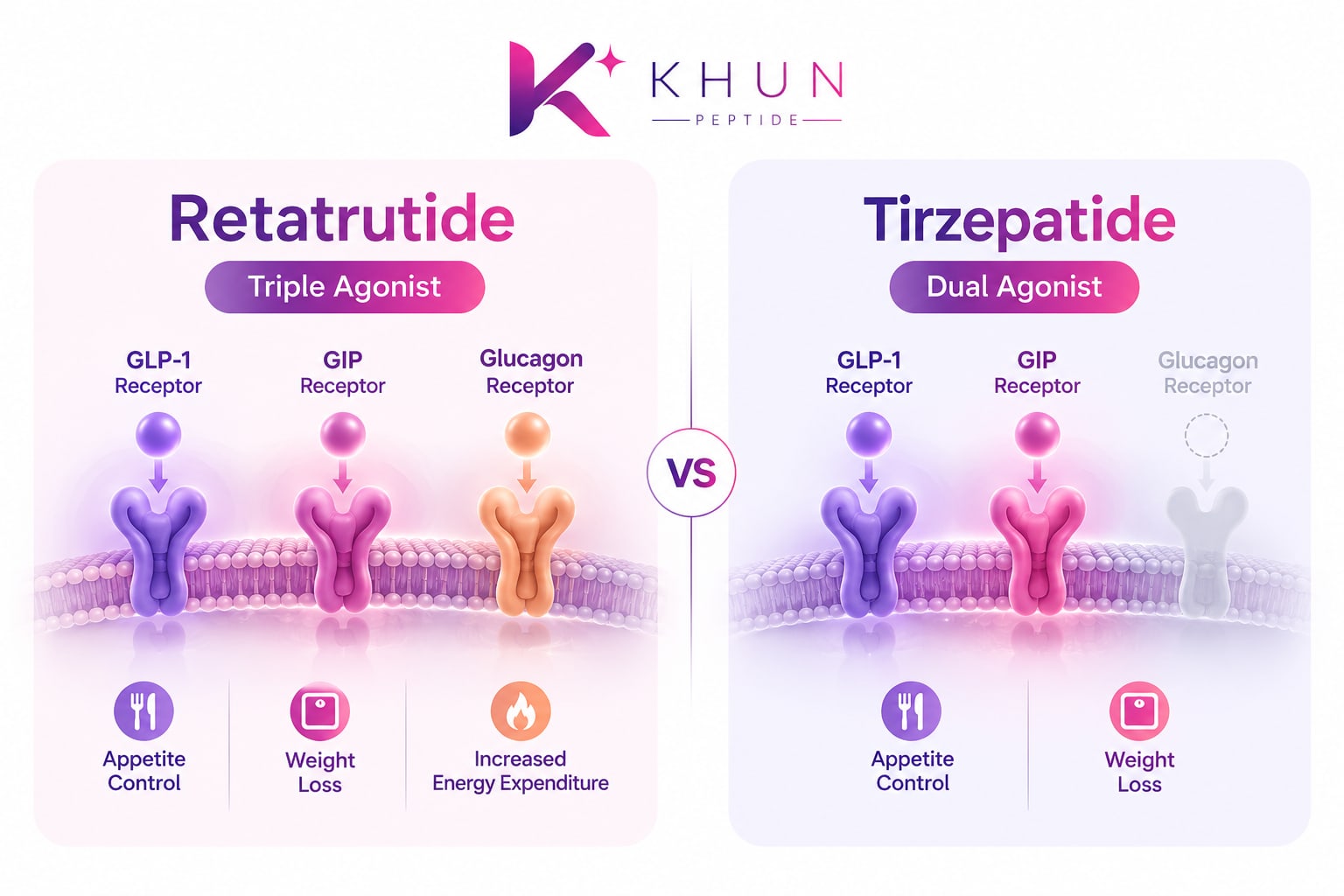
Retatrutide and Tirzepatide are two prominent molecules in metabolic and weight-management research. Both act on hormonal receptors associated with appetite, glucose regulation and energy balance, but they have different receptor profiles.
Tirzepatide is a dual receptor agonist, while Retatrutide is a triple receptor agonist.
This guide explains how these molecules differ, what their human clinical trials have reported, and what researchers and readers in Thailand should understand when comparing their evidence.
1. What Are Retatrutide and Tirzepatide?
Tirzepatide activates two hormonal receptors:
- GLP-1 (Glucagon-Like Peptide-1)
- GIP (Glucose-Dependent Insulinotropic Polypeptide)
This makes Tirzepatide a dual agonist.
Retatrutide activates three receptors:
- GLP-1
- GIP
- Glucagon
This makes Retatrutide a triple agonist.
The addition of glucagon-receptor activity is a major reason Retatrutide has attracted scientific interest.
However, a molecule targeting three receptors is not automatically more effective or safer than one targeting two. Clinical outcomes and safety findings are essential when making meaningful comparisons.
2. How Do GLP-1, GIP and Glucagon Work?
GLP-1 plays a role in satiety, appetite regulation and glucose-dependent metabolic responses.
GIP is an incretin hormone involved in responses to food intake and glucose regulation.
Glucagon contributes to glucose regulation, energy-substrate metabolism and other metabolic processes.
Researchers are investigating how activating these three pathways within one molecule influences overall metabolic outcomes.
The scientific interest in Retatrutide comes from this combination of receptor activities, rather than simply from having an additional receptor.
3. Retatrutide Phase 2 Trial Results (2023)
A Phase 2 clinical trial of Retatrutide was published in the New England Journal of Medicine in 2023.
The study enrolled 338 adults with obesity or overweight accompanied by qualifying weight-related conditions, and followed participants for 48 weeks.
Key findings included:
- A mean body-weight reduction of 24.2% in the Retatrutide 12 mg group at week 48
- A mean reduction of 2.1% in the placebo group
- Different outcomes across the treatment groups
- Gastrointestinal adverse events and dose-dependent heart-rate changes
These findings demonstrated substantial weight changes within a controlled clinical trial.
They should not be interpreted as a prediction of individual results or evidence for an unrelated commercially supplied research product.
Read the Retatrutide Phase 2 study
4. Retatrutide Phase 3 Results: The 2026 Update
An important development since the original Phase 2 trial is the publication of the TRIUMPH-1 Phase 3 study on September 29, 2026.
This randomized study enrolled 2,339 adults and evaluated Retatrutide over 80 weeks.
In the treatment-regimen analysis, researchers reported mean body-weight changes of:
- Retatrutide 4 mg: −17.6%
- Retatrutide 9 mg: −23.7%
- Retatrutide 12 mg: −25.0%
- Placebo: −3.9%
These results provide additional human clinical evidence about Retatrutide's effects on body weight.
Some reporting also cites a 28.3% figure from a different analysis approach. It is important not to mix results produced using different estimands.
Despite positive trial results, Retatrutide remains investigational as of October 2026, and regulatory approval cannot be assumed.
Read the 2026 TRIUMPH-1 publication
5. Tirzepatide SURMOUNT-1 Trial Results
Tirzepatide was evaluated in the pivotal SURMOUNT-1 Phase 3 trial, published in 2022.
The study enrolled 2,539 adults with obesity or overweight and qualifying weight-related complications, excluding diabetes.
Participants were followed for 72 weeks.
The treatment-regimen analysis reported:
- Tirzepatide 5 mg: −15.0% mean body-weight change
- Tirzepatide 10 mg: −19.5%
- Tirzepatide 15 mg: −20.9%
- Placebo: −3.1%
These findings contributed to the clinical evidence supporting Tirzepatide in weight-management medicine.
However, results from a regulated clinical trial cannot automatically be transferred to products from unrelated suppliers.
6. Retatrutide vs Tirzepatide Comparison Table
| Feature | Retatrutide | Tirzepatide | |---|---|---| | Mechanism | Triple agonist | Dual agonist | | Receptors | GLP-1, GIP, glucagon | GLP-1, GIP | | Major trial | TRIUMPH-1 | SURMOUNT-1 | | Trial duration | 80 weeks | 72 weeks | | Selected mean weight change | −25.0% (12 mg) | −20.9% (15 mg) | | US FDA status, October 2026 | Investigational | Approved for specific indications |
Important: These percentages were obtained from different clinical trials. They do not establish that one molecule is superior to the other.
Different populations, study durations, treatment protocols and statistical methods influence clinical outcomes.
7. Appetite, Weight Change and Metabolic Research
Common research topics surrounding Retatrutide and Tirzepatide include appetite regulation, body-weight reduction, waist circumference and metabolic health.
People often search for terms such as:
- Appetite control
- Weight management
- Metabolic health
- Energy expenditure
- GLP-1 and GIP research
- Triple vs dual receptor agonists
The clinical evidence shows that incretin-oriented therapies can produce significant changes in measured body-weight outcomes under study conditions.
However, these results should not be described as proof of a particular unmeasured fat-burning mechanism or as guaranteed outcomes for retail products.
8. Safety and Adverse Events
Both Retatrutide and Tirzepatide clinical trials have reported gastrointestinal adverse events, including nausea, vomiting and diarrhea.
The Retatrutide Phase 2 trial also reported changes in heart rate.
Safety findings depend on the study population, formulation, protocol and duration of treatment.
There is insufficient evidence from the cited separate studies to establish the safety or effectiveness of combining the two molecules.
Clinical efficacy and safety findings should always be assessed together.
9. Retatrutide and Tirzepatide in Thailand
When researching these compounds in Thailand, it is important to distinguish scientific literature, approved medical products and research-only materials.
Product descriptions such as Retatrutide 2.5 mg, 10 mg or 30 mg refer to labeled quantities. They do not represent validated clinical regimens.
Likewise, a product labeled Tirzepatide is not automatically equivalent to an authorized pharmaceutical formulation.
As of October 2026, Retatrutide remains investigational and is not approved by the US FDA.
Tirzepatide is the active ingredient in medicines with regulatory approvals for specific indications in certain countries.
Any claim about regulatory status in Thailand should be checked against current Thai FDA requirements and the precise product being discussed.
10. How to Interpret Clinical Trial Percentages
Weight-loss trial results are often misunderstood when figures from different publications are compared without context.
Mean weight reduction describes the average percentage change in body weight within a defined group.
Placebo-adjusted difference describes the difference between treatment and control groups.
Treatment-regimen estimand defines how the trial accounts for events that occur after randomization, including treatment discontinuation.
Trial duration determines the period over which outcomes were measured.
A 48-week result and an 80-week result should not be treated as directly interchangeable measures of comparative effectiveness.
Similarly, figures obtained using different analytical methods should not be presented as though they describe the same endpoint.
11. Final Thoughts: Which Is Better?
Retatrutide and Tirzepatide represent different approaches to targeting metabolic hormone receptors.
Tirzepatide activates GLP-1 and GIP receptors, while Retatrutide adds glucagon-receptor activity.
Both have produced substantial body-weight changes in controlled human studies. Retatrutide now has published Phase 3 obesity data from 2026, while Tirzepatide has a more established history of regulatory authorization for specified indications.
The most useful comparison considers study quality, safety findings, treatment status and appropriately matched clinical outcomes rather than simply selecting the largest reported percentage.
For readers new to peptide research, see Peptide Research in Thailand: A Beginner's Guide.
Scientific References
- Retatrutide Phase 2 Trial — New England Journal of Medicine (2023)
- Retatrutide TRIUMPH-1 Phase 3 Trial — New England Journal of Medicine (2026)
- Tirzepatide SURMOUNT-1 Trial — New England Journal of Medicine (2022)
- Eli Lilly — What to Know About Retatrutide
This article is for scientific education only. It is not medical advice, a recommendation to use investigational substances, or a guarantee of results for any commercial product.
Frequently asked questions
- What is the difference between Retatrutide and Tirzepatide?
- Tirzepatide activates GLP-1 and GIP receptors, making it a dual agonist. Retatrutide activates GLP-1, GIP and glucagon receptors, making it a triple agonist.
- Is Retatrutide more effective than Tirzepatide?
- Separate clinical trials have reported substantial weight reductions for both compounds, but percentages from different trials cannot establish superiority. A suitably designed direct comparison is needed.
- Does Retatrutide have Phase 3 clinical trial results?
- Yes. The TRIUMPH-1 Phase 3 study published in September 2026 reported a mean weight reduction of 25.0% with Retatrutide 12 mg versus 3.9% with placebo at 80 weeks using a treatment-regimen analysis.
- Does a Retatrutide 30mg label indicate a clinical dose?
- No. A 30mg label describes a stated package quantity, not a validated clinical regimen, proof of safety or evidence of regulatory approval.